
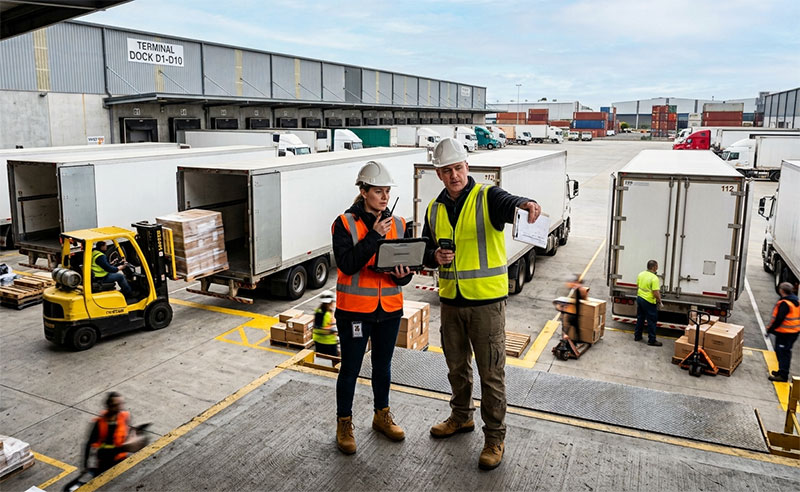
These common terms speed communication among dispatchers, freight brokers, shippers, and carriers. All these terms have their own meaning in the trucking and related industries. If you are part of the trucking community, you must know this trucking dispatch terminology. If you are confused about what a rate con, a layover, or an accessorial charge is. With that cost, you can lose a trip or a margin of profit by agreeing to the terms.
When you understand these terms, you operate with greater clarity and can negotiate more effectively.
This guide breaks down the essential dispatching terms in trucking — the ones that come up on load boards, rate confirmations, check calls, and settlement statements. Whether you're an owner-operator just getting your authority or a fleet owner expanding your operation, this freight dispatch terminology glossary is built for you.
Key Players Who Associate with Each Other: Who Does What
Behind moving every load from one location to another, a chain of parties coordinates and works. Each one plays their own role. If even one party breaks or delays communication, or withdraws from the agreement, the results will differ.
Shipper
The company or individual that needs freight moved. The shipper is the origin point — they pack the load, set the pickup appointment, and specify delivery requirements. Think of a furniture manufacturer that needs to move inventory to a retailer's distribution center. That manufacturer is the shipper.
Consignee
The party on the receiving end. Once your truck rolls up to the delivery dock, the consignee signs for the freight and takes custody of it. The consignee's name, address, and contact information will appear on the Bill of Lading(BOL).
Freight Broker
An intermediary licensed by the FMCSA to connect shippers with carriers. Brokers don't own trucks — they arrange transportation, handle paperwork between parties, and take a margin on the load. When you pull a load off a load board, you're most often dealing with a broker, not the actual shipper.
Dispatcher
What do dispatchers do? Professionals who manages the vehicle movement, whether that's an owner-operator, a third-party trucking dispatch company, or a fleet manager. Mainly, he is responsible for finding loads, negotiating rates, handling communication with brokers, and keeping the wheels rolling.
Always, a professional dispatcher turns a truck into a profitable business rather than just a vehicle.
The Documents Every Driver Touches on Every Load
Paperwork in trucking isn't optional. These documents legally protect you, confirm your rates, and get you paid. Know each one.
Bill of Lading (BOL)
The foundational shipping document. A BOL describes the freight being transported — commodity, quantity, weight, origin, and destination. It functions as a receipt issued by the carrier to the shipper and as a legal contract for the transport. If there's a freight claim, the BOL is Exhibit A.
E.g., your dispatcher books a load. At pickup, the shipper hands you a BOL with load details (45 pallets and 35,000 lbs for a dry van load of auto parts), your trailer seal number, and the delivery address. Your signing it means you've accepted the freight.
Rate Con(Confirmation)
The formal agreement between the broker and the carrier includes load details, rates, pickup and delivery addresses, scheduled times, and any special handling instructions.
If a bro er promises $2,400 by phone but the rate con says $2,100, what's on that document is what you'll get paid. Never dispatch a driver without a signed rate con in hand.
Proof of Delivery (POD)
Basically, it is a signed copy of the BOL, a delivery receipt, or a digital freight confirmation pointing to successful delivery. It is a key document for shippers or brokers to release payments for load transport. Must collect and organize POD to ensure on-time payment.
Carrier Packet
Essential documents that a broker requires to book a load with you: Insurance certificate, MC number, W-9, and a signed agreement. Every time you secure a load with a new broker, you will need them. So keep your carrier packet assembled and up front to save hours of back-and-forth.
Load Types and Equipment Terms
Not all freight moves the same way. Knowing your load types helps you identify which loads your equipment can handle and which to skip.
Full Truckload (FTL)
A load that fills — or is priced as filling — an entire trailer. The carrier hauls exclusively for one shipper from pickup to delivery. FTL loads are generally easier to dispatch and offer better per-mile rates than partial loads.
Less Than Truckload (LTL)
Freight that doesn't fill a full trailer. LTL shipments from multiple shippers are consolidated onto one truck. If you're operating as a carrier, LTL isn't typically what you'll see on the spot market — it's a specialized service model with its own terminal network.
Partial Load
That some here fall between LTL and FTL, when you're hauling for one shipper, but the freight doesn't fill the whole trailer. Partial loads can work well on specific lanes or your regular lanes. But negotiate the rate carefully based on transport costs and profit margins, since you are driving less freight for the same number of miles.
Dry Van Load
Standard enclosed trailer freight — no temperature control, no special handling. Think consumer goods, packaged food, electronics, retail merchandise. The majority of loads on major load boards are dry van, making it the most competitive trailer type.
Reefer Load
Reefer loads include everything that needs temperature-controlled transport, such as frozen foods, pharmaceuticals, and fresh produce.
Hauling a reefer load means managing determined temperatures, monitoring the unit, and maintaining cold-chain documentation. The rates are typically higher than dry van rates, as operating costs are higher.
Power Only
A power-only load means you bring only your tractor — no trailer. The shipper or broker provides a pre-loaded trailer for you to drop at the destination. Drop-and-hook operations and intermodal drayage are common examples of power-only work.
Load Boards, Freight Lanes, and Market Terms
Load Board
An online marketplace where brokers and shippers post available freight and carriers search for loads. AT and Truckstop.com are the two dominant platforms. Load boards are the open market — rates fluctuate in real time based on supply and demand. For owner-operators without dedicated contract freight, the load board is where most work originates.
Pot Market
Spot market swings based on demand and supply, where you negotiate a load for that one-time only, instead of a long-term agreement.
When capacity is tight with seasonal demand, rates may climb.
When trucks outnumber loads, rates can fall. Although fuel prices are also a key factor.
Contract Freight
Ongoing freight commitments between a shipper and carrier at a pre-negotiated rate. Contract freight offers predictability — consistent lanes, consistent rates, consistent volume. Shippers value reliable capacity; carriers value steady work. As your operation grows, securing contract lanes is one of the most effective ways to stabilize revenue.
Freight Lane
A defined corridor between an origin region and a destination region — for example, Chicago to Dallas or Los Angeles to Phoenix. Freight lanes have their own rate histories and supply-demand dynamics. Experienced dispatchers know which lanes run heavy versus which ones leave trucks sitting deadhead on the return.
Backhaul
A load that takes you back toward your home base or origin point after completing a delivery. Backhaul loads are critical for profitability — a truck moving empty in either direction is burning fuel and time without revenue. The difference between a good dispatcher and a great one often lies in how efficiently they secure a backhaul before the driver reaches the delivery point.
Fees, Charges, and Pay Terms You Need to Understand
This is where money either gets made or quietly disappears. These terms appear on your rate con and settlements — know what each one means before you sign anything.
Detention
A fee charged when a driver is held at a shipper or consignee location beyond the free time window specified in the rate con — typically two hours. Detention is meant to compensate carriers for the lost productive time and the cost of a truck sitting idle at a dock. Real-world example: Your driver arrives at a shipper at 8:00 a.m. for a scheduled appointment. The shipper doesn't start loading until 11:30 a.m. With a standard two-hour free time window, you're entitled to 1.5 hours of detention pay — typically $50–$75 per hour depending on the broker agreement. Not every broker will pay without a fight. Document it every time.
Lumper Fee
Payment for a third-party laborer who physically unloads freight at the delivery point. Lumpers are common at grocery warehouses and distribution centers. Who pays the l mper — carrier, broker, or shipper — should be clarified before dispatch. Some rate cons include lumper reimbursement; others don't mention it at all. Get it in writing.
Accessorial Charges
Any charges beyond the hauling: detention, layover pay, lumper fees, TONU, fuel surcharges, multi-stop-off charges. Accessorial charges should be agreed upon with a rate con. Later, any dispute can arise after delivery.
Deadhead Miles
Driving several miles without a load costs you fuel and hours, whether you are going to pick up a load or head back home. Deadhead miles can silently erode your profitability; keep them to a minimum. A professional dispatcher who consistently books loads with minimal deadhead is worth their weight in gold.
Fuel Surcharge
Typically, fuel surcharges are to cover fuel price fluctuations. This fuel charge is calculated per mile based on the diesel price index and negotiated alongside the base rate.
Layover
When a driver must sit overnight or for an extended period — typically due to a scheduling gap between loads or a shipper delay that pushes the next appointment to the following day- layover pay compensates the driver and carrier for lost earning time. Not all brokers offer layover pay unless it's specified in the rate con.
TONU — Truck Ordered, Not Used
Compensation paid when a carrier sends a truck to pick up a load, but the shipper cancels, or the load is no longer available. TONU rates vary but are meant to cover the cost of the dry run. If TONU isn't mentioned in your rate con and a load falls through, recovery becomes much harder.
Compliance, Authority, and Carrier Identity
MC Number
Your MC number, or Motor Carrie number, is your business identity in the freight world. When y u get the MC number from FMCSA(Federal Motor Carrier Safety Administration), it means you are now an operating authority to transport freight interstate. To book a load, you need to activate this. Brokers verify it; shippers reference it.
DOT Number
In addition to operating authority, the DOT number is used for safety tracking, audits, and inspection records. Department of Transportation provides it to cover your safety compliance history.
Per federal regulations, both numbers must be displayed on your truck doors.
Authority
Shorthand for your operating authority — the federal permission to transport regulated freight as a for-hire carrier. Getting your authority means filing with the FMCSA, securing the right insurance, and completing the mandatory waiting period. Without active authority, you're limited to leasing under another carrier's authority.
ELD — Electronic Logging Device
A federally mandated device that automatically records a driver's hours of service by syncing with the truck's engine. ELDs replaced paper logbooks for most commercial drivers. They matter in dispatch because a driver's available hours directly affect load eligibility — a driver with six hours of drive time left can't accept a 500-mile run without a 10-hour break.
Day-to-Day Operations: Terms You'll Use Every Single Day
Dispatch
The act of assigning a driver to a specific load and coordinating all the details — pickup appointment, route, delivery window, and documentation. In a broader sense, dispatch refers to the entire process of managing a truck's movement from the time a load is accepted until the POD is collected.
Check Call
Updating from the driver to the dispatcher at a specific time period or at checkpoints for location, expected arrival time, and any issues. Brokers often require check calls from the load pickup to delivery. Missed check calls hurt the overall operation and supply chain. Weakening the relationships.
ETA
Estimated Time of Arrival (ETA). All concerned parties with the load want an accurate ETA. So that they can plan dock schedules, labor hours, and downstream logistics. Updating the realistic ETA strengthens the carrier's reputation. Do it proactively when conditions change
Dro and Hook
Drop-and-hook modal where the driver drops a loaded trailer and immediately hooks to a pre-loaded trailer. In this type of freight movement, you keep trucks moving with minimal dock wait time.
Financial Terms That Affect Your Cash Flow
Factoring
A financial arrangement where a third-party factoring company purchases your unpaid invoices at a discount — typically 1% to 5% of the invoice — and pays you within 24 to 48 hours. Instead of waiting 30 to 45 days for broker payment, you get cash immediately, and the factoring company collects from the broker.
Factoring is common among small carriers and owner-operators because cash flow is the lifeblood of a trucking operation. Fuel, maintenance, and insurance don't wait for a 45-day net payment term.
Freight Broker Credit Score
A higher Credit Score means better financial reliability. Broker credit scores from different tools (Ansonia, Cortrak, and OOIDA) reflect payment history and provide an estimate of how long the broker typically takes to pay. Checking the credit score, especially for an unfamiliar one, is better than having to chase payments later.
The Terms New Owner-Operators Encounter First
If you're in your first 90 days with your authority, you'll encounter some terminology on nearly every load. These are the ones to lock in before anything else.
- Rate Con — Never move a load without one. This document is your financial protection.
- BOL — Sign it at pickup only after verifying the count and condition of the freight.
- Detention — Know your free time window and document arrival times every time.
- Deadhead Miles — Do not avoid empty miles in the rate calculation before accepting a load, especially when accepting loads off your regular lanes.
- MC Number — Keep your authority active and insurance current. Lapsed authority means no loads.
- Load Board — Also, focus on the rate history and lane data, not just on the price.
- Check Call — Proactively update your movement to your dispatcher. Brokers like it.
- POD — Get a signature at delivery. No POD means a fight to collect payment.